
From Realign's physiotherapy and chiropractic team · Langley, BC
Why Does Sitting Make My Sciatica Worse?
“I can walk around, but sitting at my desk or in the car sends pain down my leg.” We hear this pattern often at Realign. Why can a chair feel worse than moving?
Sitting may aggravate a sensitive nerve in the lower back, put pressure on irritated tissues deep in the glute, or keep you in one position too long. We look at how your symptoms change with movement before deciding what might help.
Prefer to talk first? Call 236-325-2239. Our clinic is near Willowbrook Shopping Centre.
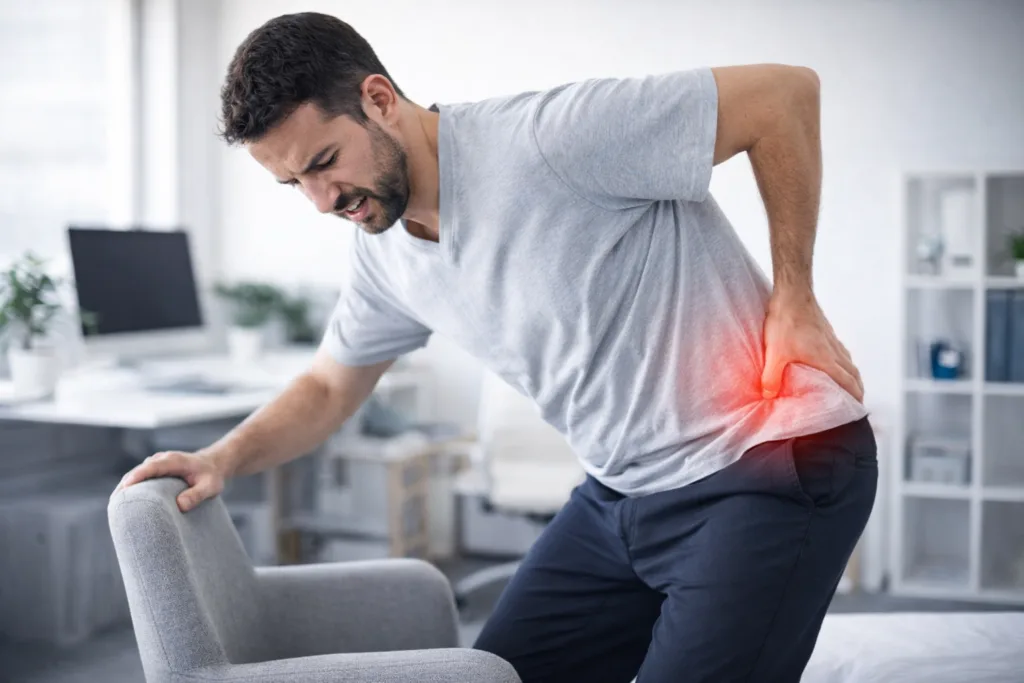
Sitting holds your hips bent and keeps pressure on your back and glutes. If a lower-back nerve root or the sciatic nerve in the deep buttock is sensitive, symptoms may build in that position. Brief position changes can help, while an assessment guides the longer-term plan.
Start with the reason
Why can sitting flare sciatic pain?
Sciatica describes pain or nerve symptoms that may travel from the back or buttock into the leg. When a patient tells us sitting makes it worse, we ask where the symptoms start, how far they travel and what happens when that person stands or walks. A chair is often a trigger for an already sensitive area, rather than proof of a new injury. Three things can matter.
For some people, the position of the low back while sitting or leaning forward makes an irritated lumbar nerve root more sensitive. Pain may travel farther into the leg, especially with a longer drive or a slumped seat.
Pressure from the seat can irritate a tender buttock. In a smaller group, the sciatic nerve may be irritated in the deep gluteal space near the piriformis and other hip rotators. This can feel similar to pain from the back.
Staying still can make a sensitive area less comfortable. A supported position may feel good at first and painful later. Small changes and short walking breaks often matter more than trying to find one perfect posture.
The terms “sciatica” and “piriformis syndrome” are often used loosely. Buttock pain alone does not prove the sciatic nerve is trapped, and not every case begins in the spine.
The clue is your symptom pattern
Is it coming from your back or your glutes?
Many people point to a tight spot in the glute or piriformis and assume that muscle is trapping the nerve. Sometimes the deep glute is involved, but a tight feeling alone cannot tell us where the symptoms begin. We look at the pain pattern, nerve signs and movements that change your symptoms before making a plan.
With a lower-back nerve root problem, symptoms may travel below the knee toward the foot and come with tingling, numbness or weakness. Buttock-focused pain that gets worse on a hard seat or with direct pressure may point toward a local glute or hip contribution. People can have features of both.
Useful observation: Does a short walk ease the leg pain? Does leaning forward worsen it? Does pressure on one buttock reproduce it? Bring those answers to your appointment.

Leg symptoms often change with back position, bending, coughing or a longer stretch of sitting. Numbness or weakness may also be present.
A glute stretch or ball is unlikely to address the main driver if the nerve root in the lower back is the source.
The worst spot may be deep in one buttock, with discomfort on a hard chair or when the hip is held in certain positions. Tenderness and hip movement may reproduce familiar symptoms.
The piriformis is one possible contributor, but other hip tissues can cause a similar pattern. A clinician can check both the hip and the back.
These are clues, not a home diagnosis. For the full overview of causes and clinic care, see our sciatica treatment in Langley page. If your symptoms are centered in the buttock, you can also read about piriformis syndrome.
Make today more manageable
What to do when sitting makes sciatica worse
We usually start with changes you can use today. You do not need to quit sitting entirely. Try the least provocative change first, notice what happens to the leg symptoms, and keep what works at work, home and in the car.
As a starting point, try getting up around every 20 to 30 minutes if your day allows. Stand, take a brief walk or do a different task for a minute or two. Use your symptom response to adjust the timing. There is no magic interval.
Keep your feet supported. Test a small lumbar roll or a firmer chair if a soft seat makes you slump. A slightly higher seat may make getting up easier. Remove a wallet from your back pocket, and avoid pressure directly on the sore buttock.
A sit-stand setup can help you change positions, but standing all day is not the goal. If standing also hurts, use shorter changes between comfortable positions. On a long drive, plan a safe stop so you can walk for a couple of minutes.
A short easy walk often feels better than staying completely still. Avoid forcing a toe-touch or strong figure-four stretch into shooting leg pain. If an exercise makes tingling spread farther down your leg or weakness increases, stop and get advice.
For a tender outer glute
Can a lacrosse ball help?
It can be a short-term comfort tool when the discomfort feels muscular around the outer or upper glute. Start with a softer tennis ball if a lacrosse ball feels too intense. Place it between the wall and the fleshy outer part of the glute, lean in gently for 20 to 30 seconds, then move away. Keep the pressure mild and breathe normally. It should feel like tolerable muscle pressure, not a jolt down your leg.
Do not dig into the central deep buttock or sit directly on the ball to chase nerve pain. Stop if it creates tingling, numbness, shooting pain or a flare that lasts. If your pain is mainly traveling into the foot, prioritize assessment over repeatedly rolling the glute.
The ball does not free a trapped nerve or correct a disc. Use it only if it helps you move more comfortably afterward. More pressure is not a better treatment.
Work on what keeps flaring it
A longer-term goal: comfortable hip internal rotation
We check how your hips move, including internal rotation, which means your thigh turns inward in its socket. If that motion is limited or uncomfortable and your symptoms have a meaningful hip or deep glute component, improving comfortable hip movement may be one part of your longer-term plan.
That does not mean every person with sciatica needs more hip rotation. It is not a proven cure for a lumbar nerve root problem. Forcing the hip into rotation can aggravate some deep gluteal symptoms, so we assess what is relevant, build range you can control and connect it to daily activities.
A gentle starting movement
Small reverse clam: Lie on your comfortable side with hips and knees loosely bent and knees stacked. Keep your knees together while lifting the top foot a small distance, then lower it slowly. That turns the top hip inward. Try five easy repetitions. Keep the range small; do not press into a pinching hip or radiating leg pain. If side-lying or this motion provokes symptoms, skip it and ask your clinician for a better option.
Later, your plan may include controlled hip rotation through a larger comfortable range, glute strength, trunk capacity and gradually rebuilding sitting tolerance. The right exercise and dose depend on whether the symptoms start at the back, the deep glute, or both.
Less time spent avoiding the chair. An easier commute. Symptoms that settle faster after a position change. Hip motion that feels smoother and is useful in walking, squatting or getting up from a seat.
Comfort and function matter more than reaching a particular hip angle.
Find sitting positions and activity breaks you can tolerate without spreading leg symptoms.
Work on hip motion when it is restricted and relevant, alongside comfortable back movement.
Strengthen the hips and trunk and gradually extend the activities that matter to you.
Care matched to the cause
What will a clinician check when sitting triggers leg pain?
At our Willowbrook clinic, we start by listening to your story: where the pain begins, how far it travels, what sitting does to it and what helps it settle. Your physiotherapist or chiropractor then checks relevant back and hip movement, strength, sensation and nerve signs. We explain the likely source, discuss whether further medical evaluation is needed and build a treatment plan around your findings and goals.
A physiotherapist can test your movement and nerve symptoms, help find a tolerable sitting routine and progress hip mobility, strength and everyday activity. Your home plan is adjusted to how symptoms respond.
Explore physiotherapy in Langley →A chiropractor can assess the low back, hip movement and neurological signs, discuss whether hands-on care fits and pair it with movement advice. Treatment is based on the findings and your preferences.
Explore chiropractic in Langley →Options chosen for your presentation
Which treatments might fit your sitting-related symptoms?
Your physio or chiropractor may recommend hands-on care alongside exercise, hip mobility and practical changes to sitting. The choice depends on whether the assessment points toward the lower back, the deep glute or another source. You do not need every treatment listed below.
If a painful or guarded glute or piriformis muscle is contributing to your symptoms, a qualified therapist may suggest dry needling to address the muscle component. It is considered alongside movement and strengthening, rather than as a stand-alone answer to nerve pain.
Learn about dry needling →For selected longer-standing gluteal soft-tissue pain, your clinician may discuss radial shockwave as an added treatment while you work on hip mobility and strength. It is aimed at the relevant soft tissue, not at a spinal nerve root.
Explore shockwave therapy →If the assessment points toward a lower-back disc-related presentation, your chiropractor can discuss whether spinal decompression is an appropriate option for you, along with its limits and alternatives. It is not a routine first step for everyone with sciatica and does not replace active rehabilitation.
See spinal decompression care →When your chiropractor finds a relevant movement restriction in the lumbar spine or sacroiliac (SI) joint, they may recommend an adjustment or a gentler mobilization. They will explain the approach and combine hands-on care with exercises and day-to-day movement advice.
Meet our Langley chiropractors →Not sure which appointment to choose? Call our Langley team at 236-325-2239.
Know when to get help
When should you seek assessment?
Book a clinical assessment if leg symptoms are new, keep returning, affect work or sleep, or include persistent numbness or weakness. If symptoms are worsening instead of settling, do not keep treating the glute on your own.
Seek urgent medical care now for new bladder or bowel control changes, numbness around the groin or saddle area, severe or progressive leg weakness, or symptoms in both legs that are rapidly worsening. New severe symptoms after a major injury also need prompt medical attention.
Questions patients ask
Sitting and sciatica: frequently asked questions
Is it my piriformis or a problem in my lower back?
Both can create buttock and leg symptoms, and sitting may aggravate either. Pain below the knee, tingling, numbness or weakness can suggest nerve involvement, but no single symptom proves the source. An assessment of the back, hip and nerve signs is the best way to choose a plan.
Should I stretch a tight piriformis?
A comfortable glute stretch may help some people, but aggressive figure-four stretching can also provoke an irritated sciatic nerve. Keep any stretch gentle and stop if tingling or leg pain spreads. Your clinician can show you whether stretching or a different movement fits your pattern.
Will a lacrosse ball cure my sciatica?
No. Gentle pressure on a tender outer glute can be a temporary comfort measure if it does not reproduce nerve symptoms. Avoid digging into the deep buttock, and do not use the ball as a substitute for assessing persistent radiating pain or weakness.
Is a standing desk better than sitting?
It can make position changes easier, which many people find useful. The goal is to alternate among comfortable sitting, standing and short walks. Standing in one position all day can be uncomfortable too.
Will improving hip internal rotation fix sciatica?
It may help if limited hip motion is contributing to your glute-related symptoms or the way you move. It is not a universal treatment for sciatica from the lower back. Test it gently and use an assessment to decide whether it belongs in your plan.
How long should I wait before getting help?
Consider an assessment sooner when symptoms are limiting sitting, driving, sleep or daily activity, or when numbness or weakness appears. Seek urgent medical attention for bladder or bowel changes, saddle numbness or progressive leg weakness.
Move forward with a clear plan
Sitting should not run your day
Tell us where the pain starts, how far it travels and how long you can sit before it builds. At Realign Chiro Physio & Rehab in Langley, we can assess the back, hip and nerve symptoms, explain what we find, and help you build a plan for work, driving and life outside the chair.
#300–20055 Willowbrook Drive, Langley, BC · 236-325-2239